
AVT-VAL-104-P · copy 003PDF
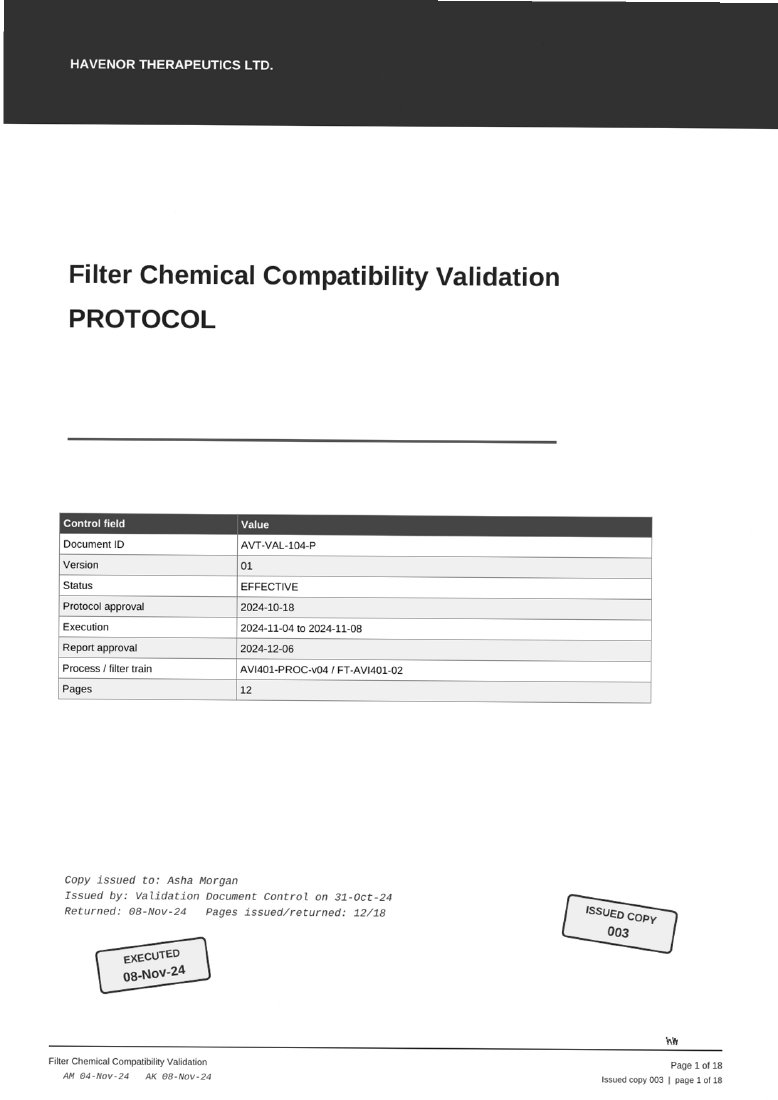
Source excerpt · Page 1; issued-and-executed copy 003
Havenor Therapeutics · Its newest medicine, Avericin, is finished and waiting for a health authority to approve it.
Task 05 · QA Product Lead
Before signing, find what in the filed shelf-life and validation records would not survive an inspector.
Claude Opus 5 caught 5 of 9 traps. See which →
3What just happened?
Before anything goes out, a Quality lead signs a release. Once filed, the records can be inspected at any time, so problems must be caught now.
4Who has to do what?
AVI-401_pre_submission_records_check.docxAudit stability and validation records, distinguish sound data from contradictory filed records, and recommend whether submission should proceed.
5Which files decide it?
The model also has the rest of the company’s shared drive, its chat and its record systems. Finding the right files is part of the job. Flip through the key ones below.
Some of the documents available to the model.
The validation package includes plans, a scanned executed copy, and a report. The reviewer has to reconcile all three.
The model must check whether the work recorded in the protocol supports the report’s conclusions.
6What did the model do?
In short: Opus reconstructs the testing chain, finds approved annexes showing 24-month chromatograms before the pull, and ranks it as the top risk.
Step 28. Finds 24-month chromatograms in an approved annex. The annex to the 18-month report labels injections as 24-month samples and cites method version v04. The 24-month pull has not happened yet.
Annex text read by the modelAVI401-R01 24-month sample MTH-HPLC-012 v04 Reviewed / reportable
Step 54. Makes the annex the headline finding. Opus ranks the annex as the finding an assessor would most likely quote back. The check still misses why the lots cannot be pooled and the open overwrap change behind the filed claim.
Text written into the checkApproved annexes to the 18-month report contain 24-month material
Bears on: The wrapper change undercuts the shelf-life claimDon’t average the batches
Replay every step of the run →
Finds 24-month chromatograms in an approved annex
AVI401-R01 24-month sample MTH-HPLC-012 v04 Reviewed / reportable
The annex to the 18-month report labels injections as 24-month samples and cites method version v04. The 24-month pull has not happened yet.
7Which traps did it catch?
Specialists wrote these checks from the real records before any model ran. Each is a weak spot a reviewer or inspector would find. A check passes only if the handed-in file states it.
The filing bases 36 months on finishing the tests and on the wrapper, but the data already project the worst batch past the limit before then.
If missed, a shelf life the data don’t support goes out under Quality’s signature.
A note explaining a problem in the bacteria test relies on a 30-minute time window that the approved test plan never mentions.
If missed, the excuse for a test problem rests on a rule that was never agreed.
The filed shelf-life claim relies on the current wrapper blocking oxygen. A pending change would replace that wrapper.
If missed, approving the change would pull the support out from under the filed shelf life.
The test batches break down at different speeds, so the worst batch alone sets the shelf life. Averaging them hides it.
If missed, the shelf life is set by an average batch instead of the one that goes bad first.
An approved annex labels samples as 24-month tests and cites a method version that doesn’t exist, but the 24-month samples haven’t even been pulled yet.
If missed, an inspector finds paperwork for impossible work — a serious record-integrity finding.
The annex cites version 04 of a test method. The version in force is 3.0; there is no version 04.
If missed, an inspector finds results tied to a method that was never issued.
The lab report says an extra study was a routine precaution; the section filed with the regulator says it was a reaction to a worrying result.
If missed, the regulator sees the company contradict itself.
The filed section calls the 0.46% result a “significant change”. It stayed within the 0.50% limit, so by definition it wasn’t one.
If missed, the filing contains a false statement.
The oxygen figure the filing relies on is the number the new supplier printed in its own letter.
If missed, the filing presents a figure from a supplier’s sales letter as established fact.
One attempt each, same assignment and checklist, so treat small gaps as noise.
AVI-401_pre_submission_records_check.docx
Talk to usRequest the full Biopharma Bench V0.1 — company environments and run receipts: team@raycaster.ai