
HA-AVI401-IR-2027-014PDF
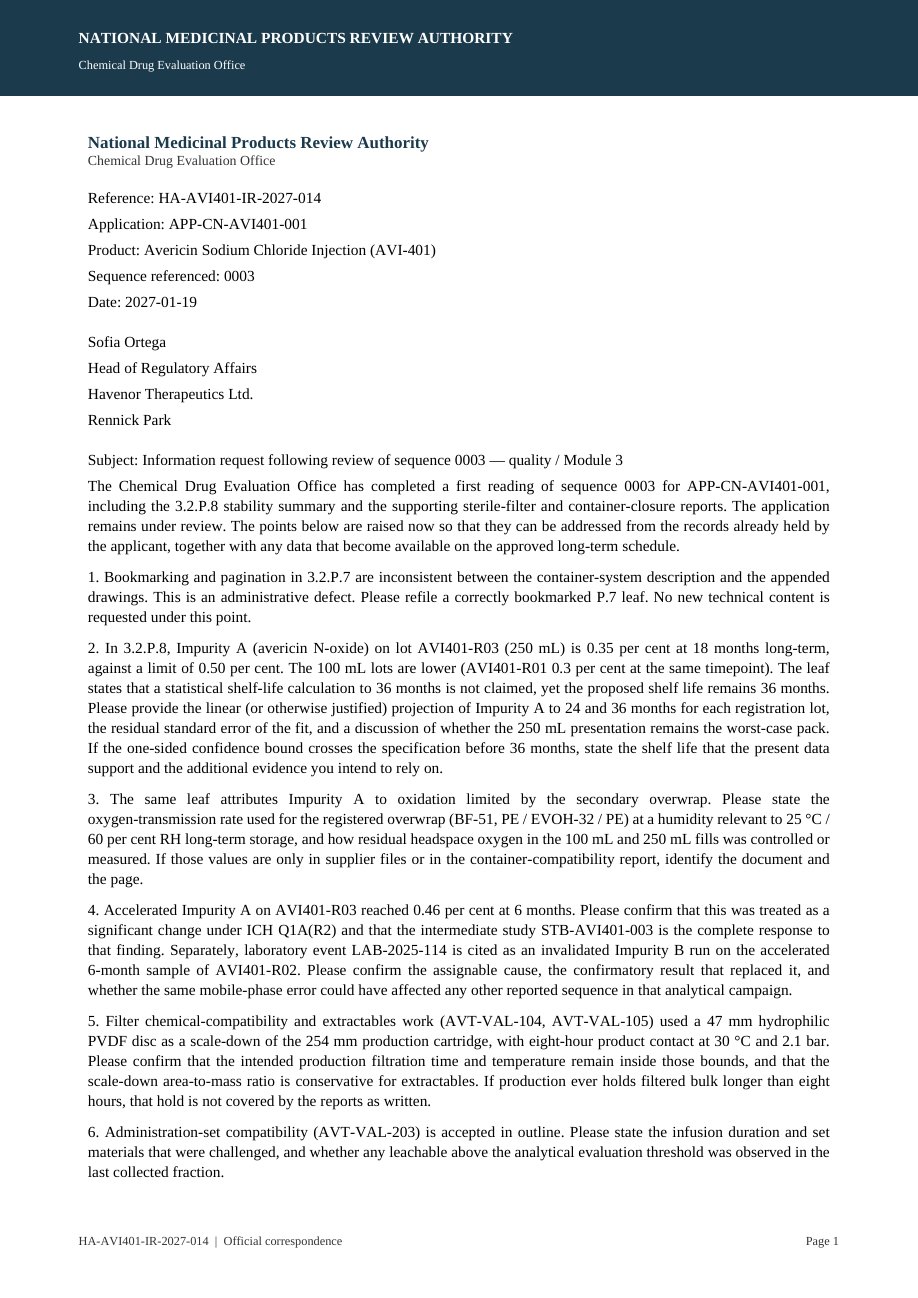
Source excerpt · Page 2, closing instruction
Havenor Therapeutics · Its newest medicine, Avericin, is finished and waiting for a health authority to approve it.
Task 04 · Regulatory CMC Manager
Draft Havenor’s answer to all seven questions, using only the evidence available today.
GPT-5.6 Sol caught 11 of 14 traps. See which →
3What just happened?
During review, a health authority can pause and ask questions. These cover shelf life, the wrapper’s oxygen barrier, filters, IV-set compatibility, a lab error and a filing mistake. The answer is due around 20 March 2027.
4Who has to do what?
HA-AVI401-IR-2027-014_response_working_draft.docxDraft a point-by-point working response with explicit evidence, calculations, filing status, and decision gates.
5Which files decide it?
The model also has the rest of the company’s shared drive, its chat and its record systems. Finding the right files is part of the job. Flip through the key ones below.
Some of the documents available to the model.
The authority asks Havenor to justify specific claims, show calculations, and distinguish known results from future evidence.
Question 7 explicitly leaves the next stability pull on its approved schedule. The response and the later commitment update are separate work.
6What did the model do?
In short: Sol drafts answers to all seven questions and computes confidence bounds showing the worst lot crosses the limit at about 27 months.
Step 10. Computes confidence bounds. Sol computes the one-sided 95% upper bound for the worst lot, which crosses the 0.50% limit at about 26.8 months.
Calculation result24 mean 0.446286 U95 0.454769; 36 mean 0.636000 U95 0.650233; U95 cross 26.778
Step 14. Proposes an 18-month shelf life. The draft response proposes 18 months. The grader expects it to tell the authority that the present data support 24 months rather than 36, and to present the projection as the applicant’s own calculation.
Text written into the responseHavenor proposes an 18-month shelf life at 25 °C/60% RH at this stage.
Bears on: Tell the regulator: 24 months, not 36
Replay every step of the run →
Computes confidence bounds
24 mean 0.446286 U95 0.454769; 36 mean 0.636000 U95 0.650233; U95 cross 26.778
Sol computes the one-sided 95% upper bound for the worst lot, which crosses the 0.50% limit at about 26.8 months.
7Which traps did it catch?
Specialists wrote these checks from the real records before any model ran. Each is a weak spot a reviewer or inspector would find. A check passes only if the handed-in file states it.
The data support 24 months. The projection is the company’s own calculation, not a formally controlled analysis, and must be labeled that way.
If missed, the regulator is told the data support a shelf life they don’t.
An approved annex labels samples as 24-month tests and cites a method version that doesn’t exist, but the 24-month samples haven’t even been pulled yet.
If missed, an inspector finds paperwork for impossible work — a serious record-integrity finding.
The wrapper’s oxygen figure is a supplier specification copied into records. Havenor never measured it, and that is exactly what the regulator asked.
If missed, a supplier’s claim is passed off as the company’s own test.
Question 1 is an administrative filing error; the answer is to refile the corrected section, while admitting the filed original isn’t on hand to check.
If missed, a paperwork fix turns into unsupported claims.
The large-bag batch rises about 0.016% a month versus 0.013% for the others, with the fit’s error reported.
If missed, the regulator can’t check the shelf-life math.
The worst batch (the large 250 mL bag) is on track for about 0.45% impurity at 24 months and 0.64% at 36, against a 0.50% limit. It crosses the limit at about 27–28 months.
If missed, nobody can check whether the claimed shelf life holds.
The test batches break down at different speeds, so the worst batch alone sets the shelf life. Averaging them hides it.
If missed, the shelf life is set by an average batch instead of the one that goes bad first.
The only oxygen figure for the current wrapper was measured at a different condition than the one asked about, and no one has measured the oxygen inside the bags.
If missed, the company overstates what it knows about oxygen protection.
An accelerated result of 0.46% stayed under the 0.50% limit, so by the international definition it isn’t a significant change.
If missed, the company admits to a problem it doesn’t have, or hides the conflict in its records.
One test run was invalidated because of a mixing mistake, and the reported result came from a confirmed re-test of the kept sample.
If missed, the regulator sees an unexplained discarded result.
The filter was tested for up to 8 hours, 30 °C and 2.1 bar, but actual production times and temperatures aren’t in the records, so conformance is a commitment to check.
If missed, the company claims a fact it can’t show.
The study only gives relative test conditions; infusion time, tubing materials and the last-drop result aren’t in it.
If missed, the answer claims detail the study doesn’t contain.
The 24-month samples are scheduled for 1 March 2027. The newest real data are from 18 months.
If missed, the company reports results it doesn’t have — falsifying the record.
The lab report says an extra study was a routine precaution; the section filed with the regulator says it was a reaction to a worrying result.
If missed, the regulator sees the company contradict itself.
One attempt each, same assignment and checklist, so treat small gaps as noise.
HA-AVI401-IR-2027-014_response_working_draft.docx
Talk to usRequest the full Biopharma Bench V0.1 — company environments and run receipts: team@raycaster.ai