
AVT-VAL-104-P · copy 003PDF
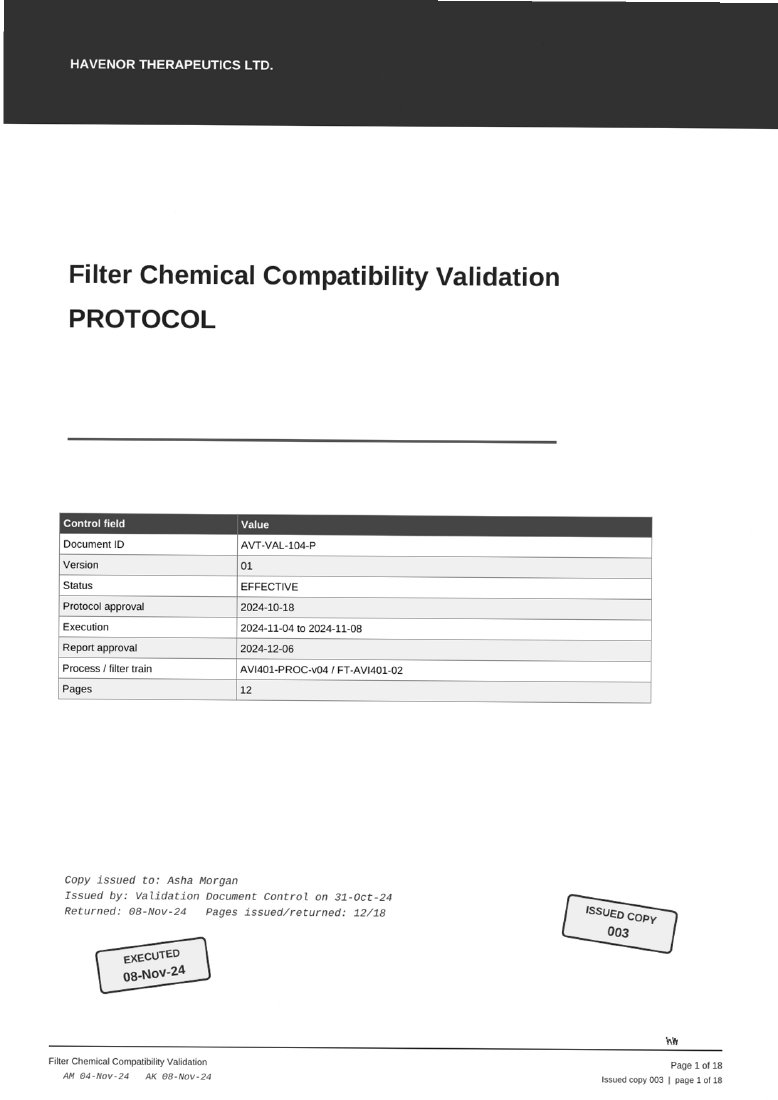
Source excerpt · Page 1; issued-and-executed copy 003
Havenor Therapeutics · Its newest medicine, Avericin, is finished and waiting for a health authority to approve it.
Task 06 · Validation Engineer
Check what in the bag-system validation package would not stand if a reviewer examined it.
Claude Opus 5 caught 5 of 9 traps. See which →
3What just happened?
The bag, ports and wrapper must keep the medicine sterile and must not leak chemicals into it. Three reports claim to prove this. Before the meeting, someone must check whether they’d hold up.
4Who has to do what?
AVI-401_ccs_validation_records_check.docxAssess whether the filed container-closure evidence can withstand review and state the unresolved gates without rewriting controlled evidence.
5Which files decide it?
The model also has the rest of the company’s shared drive, its chat and its record systems. Finding the right files is part of the job. Flip through the key ones below.
Some of the documents available to the model.
The validation package includes plans, a scanned executed copy, and a report. The reviewer has to reconcile all three.
The model must check whether the work recorded in the protocol supports the report’s conclusions.
6What did the model do?
In short: Opus views the scanned executed protocols and calibration certificates and finds that the container-closure studies have no protocols or executed records behind them.
Step 6. Reads the container-closure reports. Every report names a reviewer and approver who are not in the company roster. Opus reads these signature blocks but does not check them against the roster.
Report text read by the modelReviewed by Marta Ibrahim, Validation Engineer
Bears on: Signers who don’t work here
Step 67. Finds no protocols behind the studies. Opus compares the container-closure studies with the filter studies and finds that only the filter studies have approved protocols and executed copies.
Text written into the check2.1 The three CCS studies have no protocol and no executed record on file
Replay every step of the run →
Reads the container-closure reports
Reviewed by Marta Ibrahim, Validation Engineer
Every report names a reviewer and approver who are not in the company roster. Opus reads these signature blocks but does not check them against the roster.
7Which traps did it catch?
Specialists wrote these checks from the real records before any model ran. Each is a weak spot a reviewer or inspector would find. A check passes only if the handed-in file states it.
The reports say only “routine time + 20%”, with no actual infusion time, tubing materials or leachable limits.
If missed, nobody can tell what was actually tested.
The reviewer and approver named on the reports aren’t in the company roster.
If missed, the approvals can’t be traced to real people.
The listed author is a stability scientist, while the documents belong to a validation engineer.
If missed, authorship of key studies is unexplained.
A table cites document PROC-COMP-014 for tubing, but no such document exists anywhere.
If missed, a key claim rests on nothing.
All three reports say an approved protocol defined the study, but no protocol exists for any of them, unlike the filter studies.
If missed, the studies can’t be shown to have followed a pre-agreed plan.
The reports share the same approval dates and the same wording for their observations, instead of reading like separate studies.
If missed, an inspector suspects the records were manufactured.
Every report mentions a discarded stability-lab run as having “no impact”, though it has nothing to do with these studies.
If missed, boilerplate is mistaken for real evidence.
The IV-set report’s “representative figure” is the same generic process diagram printed earlier in the report, not a result.
If missed, a diagram passes for evidence.
The job is the registered bag system. The proposed wrapper change is a separate issue and shouldn’t become the main finding.
If missed, the review drifts to a different question and misses its own.
One attempt each, same assignment and checklist, so treat small gaps as noise.
AVI-401_ccs_validation_records_check.docx
Talk to usRequest the full Biopharma Bench V0.1 — company environments and run receipts: team@raycaster.ai