
AVT-VAL-104-P · copy 003PDF
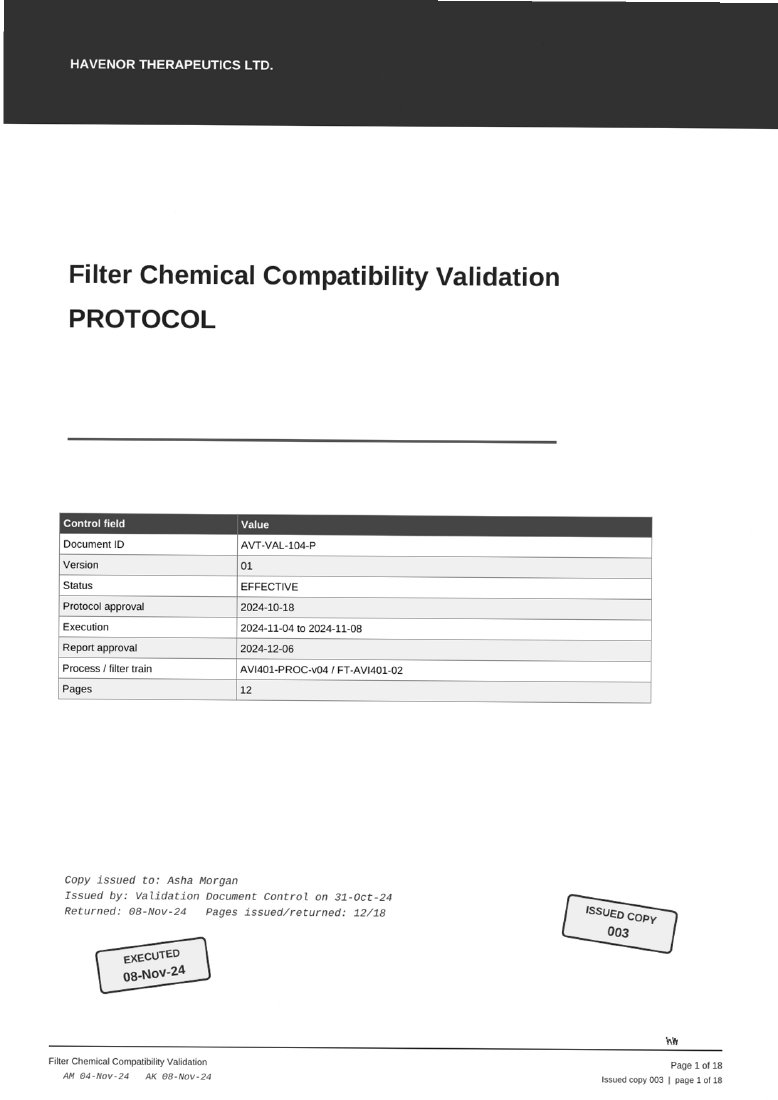
Source excerpt · Page 1; issued-and-executed copy 003
Havenor Therapeutics · Its newest medicine, Avericin, is finished and waiting for a health authority to approve it.
Task 03 · Principal MSAT Engineer
Review whether the filter-validation package would hold up in front of the regulator.
Claude Opus 5 caught 5 of 9 traps. See which →
3What just happened?
Avericin is sterilized by pushing it through a filter fine enough to hold back bacteria. A package of four validation studies proves the filter works. Before the meeting, someone must check it would survive a reviewer’s questions.
4Who has to do what?
AVI401_filter_validation_defensibility_review.docxReview the approved and executed evidence, then write an inspector-facing defensibility assessment without changing controlled records.
5Which files decide it?
The model also has the rest of the company’s shared drive, its chat and its record systems. Finding the right files is part of the job. Flip through the key ones below.
Some of the documents available to the model.
The validation package includes plans, a scanned executed copy, and a report. The reviewer has to reconcile all three.
The model must check whether the work recorded in the protocol supports the report’s conclusions.
6What did the model do?
In short: Opus reads the validation reports and views the scanned executed protocols page by page before writing an inspector-facing review.
Step 9. Reads the retention report. The approved bacterial-retention report assesses its observation against a 30-minute inoculation window and says the protocol defines it.
Report text read by the modelthe protocol-defined 30-minute window
Step 21. Opens the executed-protocol scans. Opus renders the scanned executed copy of the retention protocol and views the page images directly, because the scan has no text layer.
Image opened by the model/tmp/e107-14.png
Step 51. Repeats the report’s window. The review repeats the 30-minute window as protocol-defined. It never checks the approved protocol, which contains no such window, so the grader marks the finding as missed.
Text written into the reviewassessed against the protocol-defined 30-minute window
Replay every step of the run →
Reads the retention report
the protocol-defined 30-minute window
The approved bacterial-retention report assesses its observation against a 30-minute inoculation window and says the protocol defines it.
7Which traps did it catch?
Specialists wrote these checks from the real records before any model ran. Each is a weak spot a reviewer or inspector would find. A check passes only if the handed-in file states it.
The package links the “bubble point” check to bacteria removal, but not the second integrity check (“diffusive flow”) that the specification also uses.
If missed, a routine check is trusted without proof that it detects a bad filter.
A note explaining a problem in the bacteria test relies on a 30-minute time window that the approved test plan never mentions.
If missed, the excuse for a test problem rests on a rule that was never agreed.
The results cover at most 8 hours of contact, 30 °C and a 2.1 bar pressure drop, and nothing beyond.
If missed, the filter could be run outside the conditions it was tested for.
One issue in the bacteria study was accepted as-is; two other issues were investigated and closed. They are different outcomes.
If missed, an accepted risk is presented as a resolved one.
All four studies meet their approved criteria. What’s in doubt is the evidence of how they were run.
If missed, the review attacks passing results instead of the real gaps.
Tests used a small 47 mm disc (13.8 cm²). No area, flow or throughput is recorded for the full-size production cartridge.
If missed, nobody can show the lab test represents the factory filter.
One acceptance rule depends on the bacteria-removal report, yet it was signed before that report existed.
If missed, a conclusion is accepted that couldn’t have been supported when it was signed.
The filters held back far more bacteria than the minimum (about 1.2–1.4 × 10⁸ per cm² against 10⁷), with none getting through.
If missed, the review undersells results that are genuinely strong.
Because the production cartridge’s filter area appears nowhere in the records, no ratio between test and production filter can be worked out from them.
If missed, a number gets invented from outside the record.
One attempt each, same assignment and checklist, so treat small gaps as noise.
AVI401_filter_validation_defensibility_review.docx
Talk to usRequest the full Biopharma Bench V0.1 — company environments and run receipts: team@raycaster.ai