
CC-AVI401-017XLSX
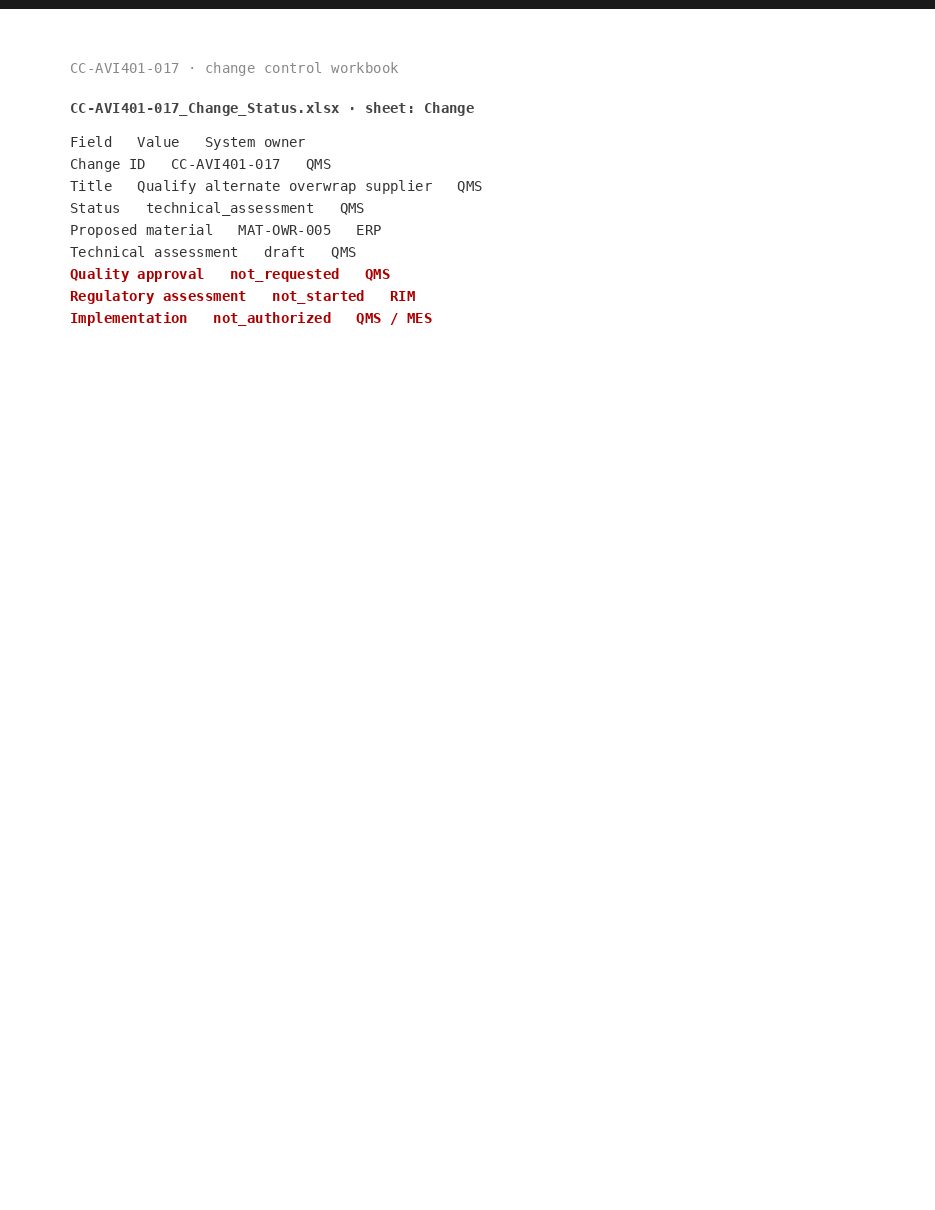
Source excerpt · Change!A1:C9
Havenor Therapeutics · Its newest medicine, Avericin, is finished and waiting for a health authority to approve it.
Task 02 · Head of CMC and MSAT
Give the engineering team’s position on what the proposed wrapper means for what was filed with the regulator.
GPT-5.6 Sol caught 7 of 11 traps. See which →
3What just happened?
The wrapper keeps oxygen away from the medicine. Because Avericin is under review, any change to its packaging may have to be reported to the regulator. The regulatory team wants the engineers’ view first.
4Who has to do what?
CC-AVI401-017_CMC_regulatory_impact_brief.docxDistinguish the proposed alternate overwrap from the registered barrier system and state the evidence and decisions still required.
5Which files decide it?
The model also has the rest of the company’s shared drive, its chat and its record systems. Finding the right files is part of the job. Flip through the key ones below.
Some of the documents available to the model.
The proposed film already has a material ID. This workbook shows how far the change has actually progressed.
The proposed material exists in the record. Quality approval has not been requested, and implementation is not authorized.
6What did the model do?
In short: Sol compares the two films’ barriers, projects the worst lot’s impurity level at 36 months, and checks the rendered brief page by page.
Step 13. Projects the worst lot to 36 months. Sol’s own regression puts the 250 mL lot at 0.636% at 36 months, above the 0.50% limit. The brief does not connect this to the change: a weaker oxygen barrier acts on the impurity that already limits shelf life.
Calculation resultR03 int 0.06685714285714286 slope 0.015809523809523808 24 0.4462857142857143 36 0.6359999999999999
Bears on: Shelf life is already tight
Step 15. Weighs the two films. Sol notes that the water-vapour advantage does not offset the weaker oxygen barrier. It takes both films’ figures from the proposing supplier’s letter without tracing where the incumbent film’s figure came from.
Text written into the briefHF-55 is ~20% lower for WVTR; this does not offset oxygen risk.
Bears on: The supplier graded its own homework
Step 18. Checks its own rendered pages. Before finishing, Sol renders the brief to images and inspects the pages for layout problems.
File opened by the model/tmp/pages/p-5.png
Replay every step of the run →
Projects the worst lot to 36 months
R03 int 0.06685714285714286 slope 0.015809523809523808 24 0.4462857142857143 36 0.6359999999999999
Sol’s own regression puts the 250 mL lot at 0.636% at 36 months, above the 0.50% limit. The brief does not connect this to the change: a weaker oxygen barrier acts on the impurity that already limits shelf life.
7Which traps did it catch?
Specialists wrote these checks from the real records before any model ran. Each is a weak spot a reviewer or inspector would find. A check passes only if the handed-in file states it.
The current wrapper film is the approved one. The new film is only proposed: on hold, not approved by Quality, not assessed by Regulatory, not authorized.
If missed, a proposal gets treated as a done deal.
The existing filter and container tests were done with the current wrapper. Whether they apply to the new film still has to be reviewed.
If missed, the new wrapper would be treated as tested when it never was.
The “new film is as good as the old one” comparison uses the new supplier’s numbers for both films. Nothing from the current supplier confirms the old film’s figure.
If missed, a weaker oxygen barrier could get through, and the medicine could break down before its expiry date.
The data already point to about 24 months against a 36-month claim. A film that lets in more oxygen acts on the very impurity that is setting that limit.
If missed, the riskiest possible change is handled like a routine one.
At both reported conditions the new film lets through more oxygen: 2.1 vs 0.8, and 3.8 vs 2.4.
If missed, a weaker barrier is accepted as equal.
The impurity that limits shelf life forms when the medicine reacts with oxygen, so the new film’s better moisture barrier doesn’t make up for its worse oxygen barrier.
If missed, the films are compared on the wrong property.
The supplier measured at 23 °C, not at the 25 °C / 60% humidity storage condition.
If missed, the comparison is stretched beyond what was actually measured.
The ongoing shelf-life study assumes the current wrapper. A weaker film needs new bridging tests before it can be used.
If missed, the shelf-life claim loses its support.
The supplier suggests a sealing temperature, but it has never run Havenor’s machines and there is no Havenor setting to compare against.
If missed, badly sealed wrappers could let oxygen in.
The supplier’s notification is just a letter and the assessment is an unapproved draft; neither makes the new film qualified.
If missed, paperwork in progress is treated as proof.
The supplier says its film fits the existing bag sizes, but Havenor’s own drawing of the part is still listed as missing.
If missed, wrappers that don’t fit could reach the packing line.
One attempt each, same assignment and checklist, so treat small gaps as noise.
CC-AVI401-017_CMC_regulatory_impact_brief.docx
Talk to usRequest the full Biopharma Bench V0.1 — company environments and run receipts: team@raycaster.ai