
HA-AVI401-IR-2027-014PDF
Source excerpt · Page 2, closing instruction
Havenor Therapeutics · Its newest medicine, Avericin, is finished and waiting for a health authority to approve it.
Task 01 · Regulatory CMC Manager
Draft the next shelf-life update using only the evidence available today.
DeepSeek V4.1 Flash caught 5 of 11 traps. See which →
3What just happened?
Shelf life is how long a medicine stays within its safety limits. Havenor claimed 36 months and must keep sending new test results to back that up. The next update is due 30 April 2027.
4Who has to do what?
COM-AVI401-008_next_stability_update_draft.docxDraft the next stability commitment update without reporting a pending 24-month result or stepping beyond the authority of a working draft.
5Which files decide it?
The model also has the rest of the company’s shared drive, its chat and its record systems. Finding the right files is part of the job. Flip through the key ones below.
Some of the documents available to the model.
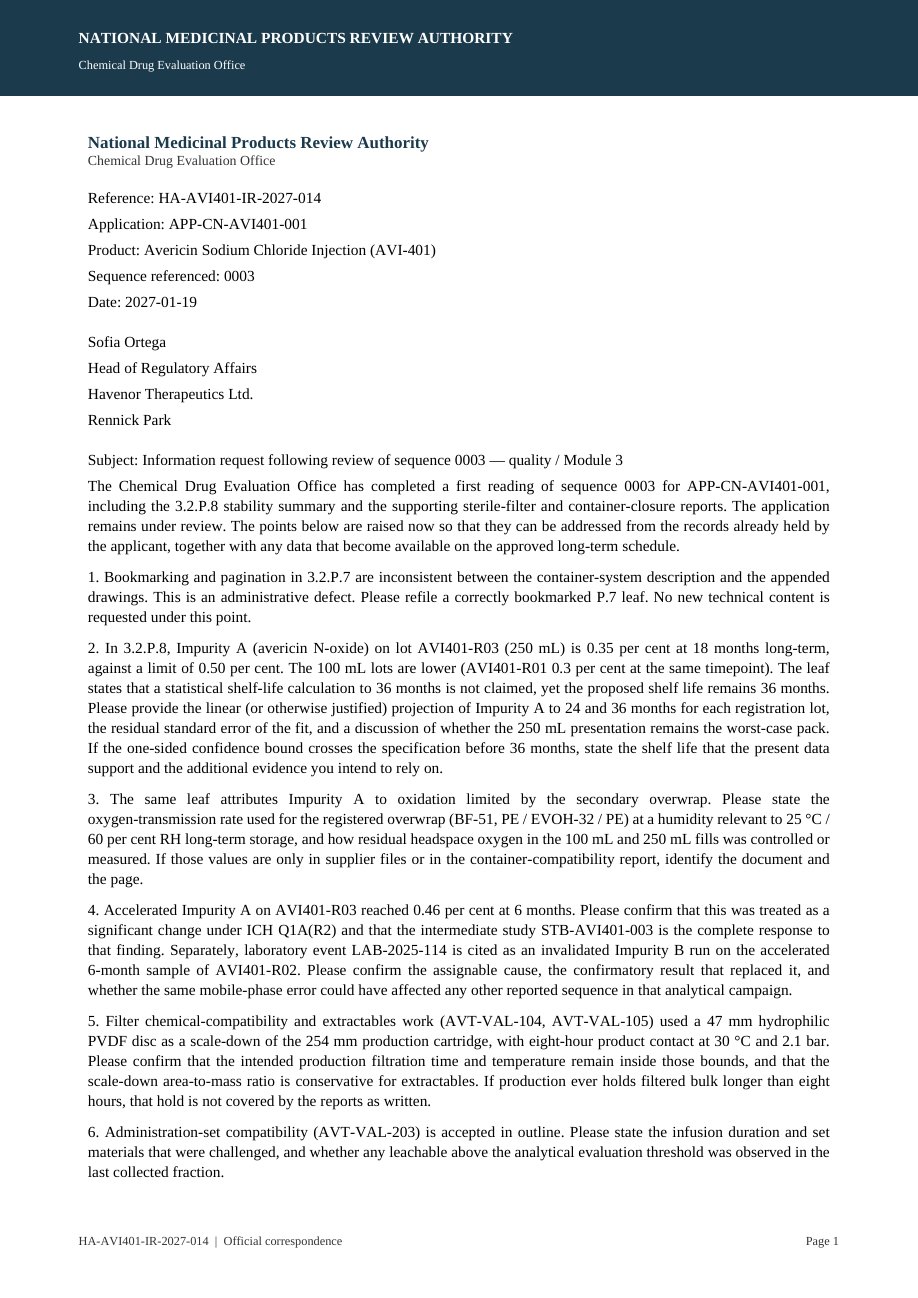
The authority asks Havenor to justify specific claims, show calculations, and distinguish known results from future evidence.
Question 7 explicitly leaves the next stability pull on its approved schedule. The response and the later commitment update are separate work.
6What did the model do?
In short: DeepSeek recalculates each lot’s impurity trend, holds back annexes with unexplained 24-month content, and concludes that 30 and 36 months are unsupported.
Step 31. Fits each lot separately. DeepSeek fits a separate regression to each lot, and the 250 mL lot crosses the limit first. The draft never states the reason this matters: the slopes differ, so the lots cannot be pooled and the worst lot governs shelf life.
Calculation resultAVI401-R03 (250 mL) 0.01581 27.4 26.8
Bears on: Don’t average the batches
Step 48. Holds back the suspicious annexes. The draft keeps the annexes’ 24-month content out of the update until someone reconciles where it came from. It never says why this matters: the 24-month samples have not been pulled, and the cited method version is not in force.
Text written into the draftThe 24-month content of those annexes must not be used in this update until provenance is reconciled and verified results exist in LIMS.
Bears on: A record of tests that haven’t happened
Step 51. Says 30 and 36 months are unsupported. The draft concludes that the data support 24 months but not 30 or 36. It does not say that completing the remaining pulls cannot rescue 36 months, because the projected mean itself exceeds the limit.
Draft text read back30 and 36 months are not supported on the worst case
Bears on: Say it plainly: 24 months, not 36
Replay every step of the run →
Fits each lot separately
AVI401-R03 (250 mL) 0.01581 27.4 26.8
DeepSeek fits a separate regression to each lot, and the 250 mL lot crosses the limit first. The draft never states the reason this matters: the slopes differ, so the lots cannot be pooled and the worst lot governs shelf life.
7Which traps did it catch?
Specialists wrote these checks from the real records before any model ran. Each is a weak spot a reviewer or inspector would find. A check passes only if the handed-in file states it.
The test batches break down at different speeds, so the worst batch alone sets the shelf life. Averaging them hides it.
If missed, the shelf life is set by an average batch instead of the one that goes bad first.
Today’s data support 24 months. Waiting for more results won’t rescue 36 months, because even the central estimate crosses the limit.
If missed, bags could be used after the point where they stay within limits.
The strength and the other impurities stay within limits well past 36 months, so this one impurity alone sets the shelf life.
If missed, another failing measurement could go unnoticed.
The update is due 30 April. The regulator’s questions run on their own 60-day clock ending around 20 March.
If missed, the earlier deadline slips by.
An approved annex labels samples as 24-month tests and cites a method version that doesn’t exist, but the 24-month samples haven’t even been pulled yet.
If missed, an inspector finds paperwork for impossible work — a serious record-integrity finding.
The filed shelf-life claim relies on the current wrapper blocking oxygen. A pending change would replace that wrapper.
If missed, approving the change would pull the support out from under the filed shelf life.
One impurity in the large 250 mL bag batch rises fastest, about 0.016% a month versus 0.013% for the others.
If missed, the shelf life is based on a batch that isn’t the worst case.
The worst batch (the large 250 mL bag) is on track for about 0.45% impurity at 24 months and 0.64% at 36, against a 0.50% limit. It crosses the limit at about 27–28 months.
If missed, nobody can check whether the claimed shelf life holds.
The 24-month samples are scheduled for 1 March 2027. The newest real data are from 18 months.
If missed, the company reports results it doesn’t have — falsifying the record.
Report 301 is current; report 302 has been replaced. The numbers must come from 301.
If missed, the update is built on an outdated document.
The lab report says an extra study was a routine precaution; the section filed with the regulator says it was a reaction to a worrying result.
If missed, the regulator sees the company contradict itself.
One attempt each, same assignment and checklist, so treat small gaps as noise.
COM-AVI401-008_next_stability_update_draft.docx
Talk to usRequest the full Biopharma Bench V0.1 — company environments and run receipts: team@raycaster.ai