
AVT-SPEC-022 · v4.0DOCX
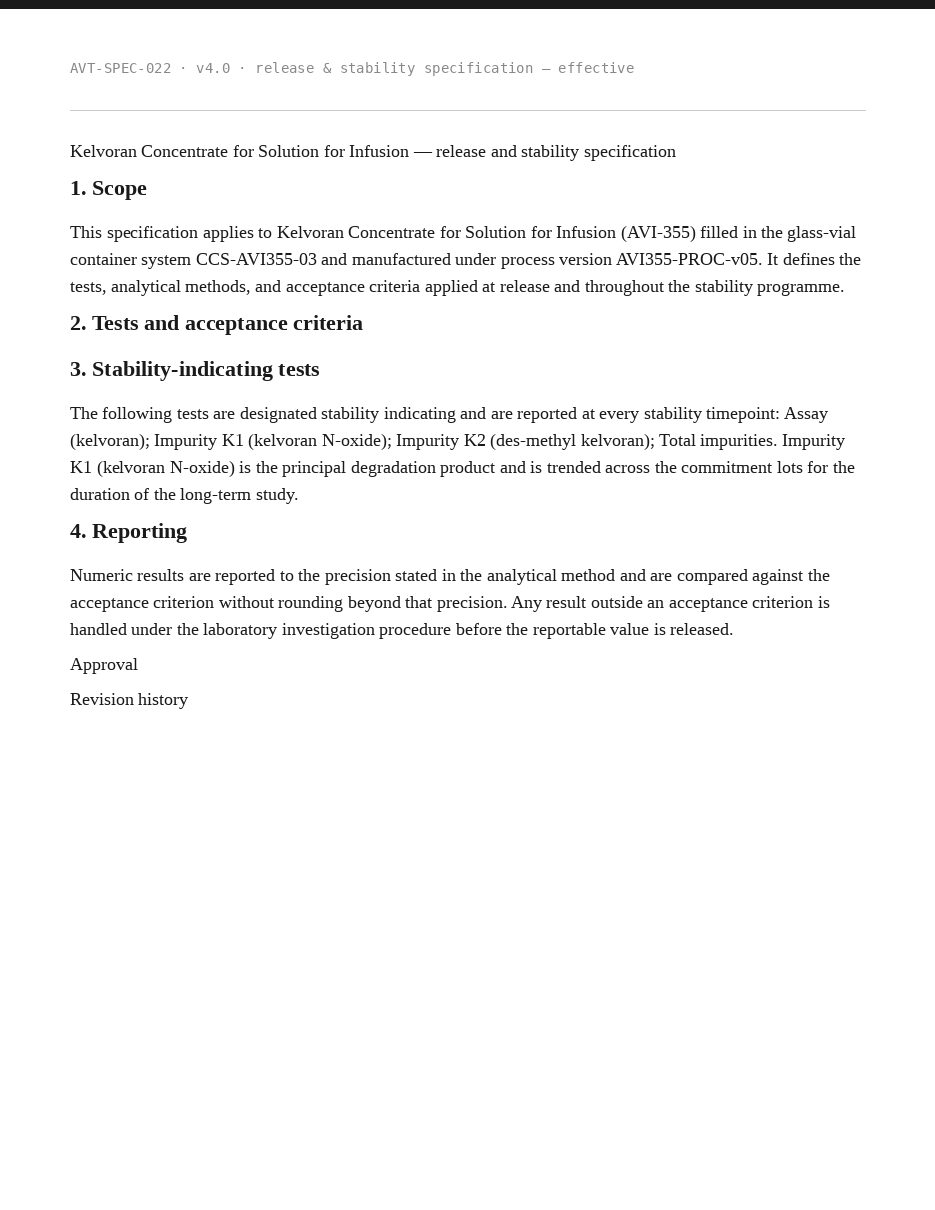
Source excerpt · AVT-SPEC-022 v4.0 and retained v3.0; STB-AVI355-011
Havenor Therapeutics · Its newest medicine, Avericin, is finished and waiting for a health authority to approve it.
Task 08 · QA Product Lead
Check every reported result against the limits in force today and set out anything that fails.
GPT-6.1 Sol caught 6 of 12 traps. See which →
3What just happened?
Companies keep testing batches after launch. Kelvoran’s limit for one impurity was recently tightened from 0.30% to 0.20%. Someone asked whether all the reported results still pass.
Workspace cutoff date: 27 September 2026.
4Who has to do what?
AVI-355_specification_acceptability_check.docxA question has come up on the Kelvoran (AVI-355) commitment-lot stability results: are all the reported results acceptable against the specification, or is any result out of specification? Confirm the position against the specification that is in force, and set out any result that does not meet it, with the reasoning an inspector would expect. Write the check to _Working/Leena Rao/AVI-355_specification_acceptability_check.docx.
5Which files decide it?
The model also has the rest of the company’s shared drive, its chat and its record systems. Finding the right files is part of the job. Flip through the key ones below.
Some of the documents available to the model.
The same stability result passes the retained superseded limit and fails the effective specification.
Version 4.0 is effective and sets Impurity K1 at NMT 0.20%. Applying superseded version 3.0 would hide the C22 accelerated excursion.
6What did the model do?
In short: Sol applies the effective 0.20% limit rather than the retired 0.30% limit, flags lot C22’s 0.24% result, confirms the other lots and measurements, and notes that no investigation covers the failure.
Step 6. Finds the AVI-355 specifications and stability workbooks. Sol locates both versions of specification AVT-SPEC-022 and the accelerated and long-term stability datasets for Kelvoran.
Tool call recorded in sessiontext(await tools.exec_command({cmd:"pwd && rg --files -g 'AGENTS.md' -g '*.docx'
Step 12. Checks the commitment lots against the effective 0.20% limit. Sol evaluates the stability pulls against effective AVT-SPEC-022 v4.0 (0.20%), flagging the 0.24% accelerated Impurity K1 failure on lot C22 while confirming C21 and C23 pass.
Tool call recorded in sessionconst results=await Promise.allSettled([
Step 21. Writes the acceptability check, stopping short of the long-term C22 trend. Sol rejects the superseded 0.30% limit and notes the missing investigation, but does not project C22's rising long-term K1 slope to its ~26–27 month crossing before the 36-month expiry.
Tool call recorded in sessiontext(await tools.exec_command({cmd:"python3 - <<'PY'\np='/tmp/avi355-review/crea
Bears on: Spot the trend before it failsThe newest data are from 18 monthsThe accelerated study is closed and finalKeep the failure and the trend distinct
Replay every step of the run →
Finds the AVI-355 specifications and stability workbooks
text(await tools.exec_command({cmd:"pwd && rg --files -g 'AGENTS.md' -g '*.docx'
Sol locates both versions of specification AVT-SPEC-022 and the accelerated and long-term stability datasets for Kelvoran.
7Which traps did it catch?
Specialists wrote these checks from the records in the workspace. Each is a weak spot a reviewer or inspector would find. A check passes only when the submitted file provides the required evidence.
In long-term storage C22 is still within the limit, but rising; it reaches 0.20% around 26–27 months, before its 36-month expiry.
If missed, batches on shelves could fail before their expiry date.
The 24-month long-term results are scheduled but not reported yet.
If missed, the check relies on data that don’t exist.
The accelerated study is complete, so the 0.24% 6-month result is a final reported failure on a closed study, not a provisional number.
If missed, a confirmed failure is treated as tentative.
The 6-month accelerated result is already out of specification, whereas the long-term results are still within 0.20% today but trending toward failure around months 26–27.
If missed, a current failure and a future trend risk get blurred together.
The long-term study backs a 36-month shelf life, so clearing every current long-term pull without checking the slope still misses that C22 will breach before 36 months.
If missed, passing today’s pulls hides the shelf-life failure ahead.
Passing long-term pulls up to 18 months do not offset or reopen the completed accelerated study’s 0.24% out-of-specification result.
If missed, normal long-term data are used to excuse an accelerated failure.
The current specification caps the impurity at 0.20%. The old 0.30% version has been replaced.
If missed, a failing batch looks fine.
Batch C22 measured 0.24% at 6 months. That fails the 0.20% limit and would only have passed the old one.
If missed, an out-of-limit medicine stays on the market unexamined.
Batches C21 and C23 are about 0.17%, within the limit, and all other measurements pass, so C22 is the isolated problem.
If missed, nobody knows how big the problem is.
The only open investigation is about a different test on a different batch. The C22 failure has none.
If missed, a failed result stands with nobody looking into it.
Concluding that no result fails because 0.24% was below the retired 0.30% limit misapplies document control by ignoring the effective version.
If missed, retired specifications are used to pass failing batches.
The superseded specification version 3.0 may be cited only as historical context and cannot govern current acceptability.
If missed, an obsolete specification is treated as active.
One published attempt each, on the same assignment and checklist, so treat small gaps as noise.
Scores on this page are from the published biopharma-bench@v0.2 package (130 checks across these ten tasks).
AVI-355_specification_acceptability_check.docx
Talk to usRequest the full Biopharma Bench V0.2, company environments and run receipts: team@raycaster.ai