
IND 167326 · Ref ID 5570921PDF
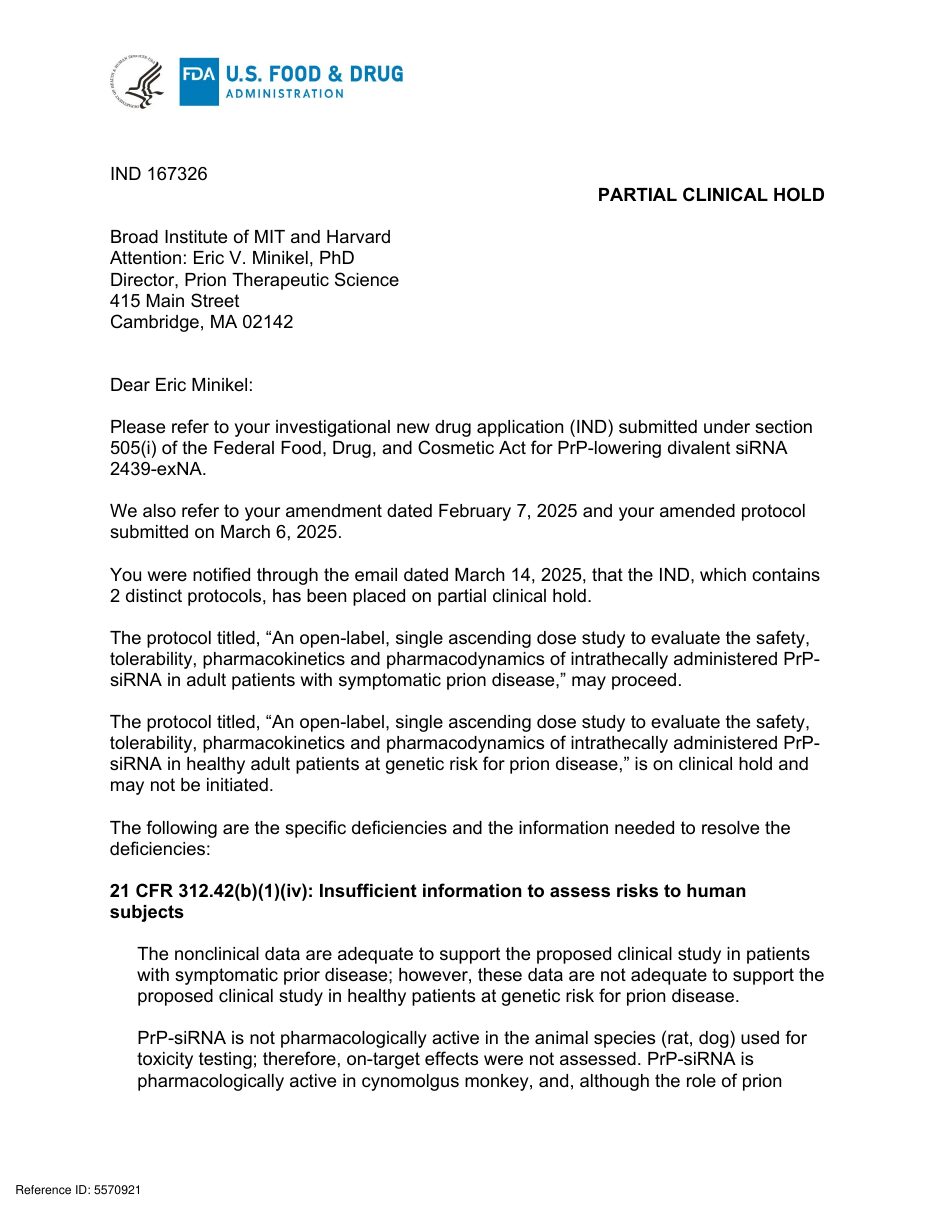
Source excerpt · Letter ¶1–3; signature page, April 11, 2025The letter itself misspells the asset name — “2349-exNA” — a detail preserved verbatim from the public record.
Broad Institute · Its drug, 2439-exNA, is ready for its first human studies, but the FDA has frozen one of them.
Task 04 · CMC technical writer
Rebuild the strength and dose arithmetic from the chemical formulas and records, and say which filed numbers must change before the lab writes back.
Claude Opus 5 caught 12 of 13 traps. See which →
3What just happened?
A drug’s strength can be counted with or without the salt it is packaged as, and the difference matters for dosing. The FDA asked which basis the lab uses. Before answering, someone must check every number.
4Who has to do what?
Strength_Potency_Active_Moiety_Position.docxRebuild the dose and formulation arithmetic from first principles, find where the filed numbers are wrong, and write the corrected technical position.
5Which files decide it?
The model also has the rest of the company’s shared drive, its chat and its record systems. Finding the right files is part of the job. Flip through the key ones below.
Some of the files the model worked from.
FDA placed the presymptomatic study on partial clinical hold because the required animal safety study was never run. Until the agency says otherwise, no activity under that protocol may begin.
Two protocols, two different answers: the symptomatic study may proceed; the presymptomatic study may not be initiated. Every file in this record exists to answer this letter.
6What did the model do?
In short: It recomputes every molecular weight from the filed formulas — catching a two-sodium error in the filing’s own salt masses — and derives the buffer arithmetic no filed document shows.
Step 2. Sees the dated extract — and never opens it. The very first directory listing shows a dated copy of the vendor's antisense sequence table sitting next to the current one — a version conflict planted in plain sight. Across the whole run it is never opened. The one failed check of thirteen.
File listingantisense_sequences_2025-03-10
Bears on: Catch the corrupted sequence export
Step 21. Recomputes every molecular weight from the formulas. The model derives each molecular weight from the filed molecular formulas rather than reciting the filing's own numbers — and finds the filing's salt masses are off by exactly two sodium ions per antisense strand. This is the check a regulator would run.
Molecular-weight recomputationDUP Na76 26623
Step 32. Derives the buffer math the filing never did. It computes molarity for every buffer component and shows the magnesium-to-drug ratio is ~26:1 — the consistency gap between the dog tox formulation and the human product that no filed document states. Then it writes the position paper.
Buffer arithmeticratio 25.95
Replay every step of the run →
Sees the dated extract — and never opens it
antisense_sequences_2025-03-10
The very first directory listing shows a dated copy of the vendor's antisense sequence table sitting next to the current one — a version conflict planted in plain sight. Across the whole run it is never opened. The one failed check of thirteen.
7Which traps did it catch?
Specialists wrote these checks from the real records before any model ran. Each is a weak spot a reviewer or inspector would find. A check passes only if the handed-in file states it.
An older vendor export collapsed 36 candidate sequences into one identical string; the corrected table is the source of record.
If missed, the paper relies on corrupted data.
By FDA policy, strength is stated for the drug itself (the “free acid”), not including its sodium salt.
If missed, patients could get a different amount than the label implies.
The filed formula wrongly adds sodium to the salt-free form, and the salt weights miss some sodium.
If missed, every number built on them is off.
The assay section of the filing sets the strength basis and governs when others are vague.
If missed, conflicting sections have no tiebreaker.
The recipe section doesn’t say whether amounts include salt; the position must pick “as free acid”.
If missed, the ambiguity stays in the filing.
10 mg/mL is total drug as free acid, measured by light absorbance with a stated conversion factor.
If missed, the label strength can’t be checked.
Confirm that any future salt form will also be labeled by free acid, and whether the current filing already complies.
If missed, the FDA’s question stays open.
34.61 g of salt in about 3 L at 10 mg/mL implies a specific drug-content factor that must be stated.
If missed, the recipe and label may not match.
Corrected, sodium is about 6.6–6.9% of the weight; the filed 5.95% is wrong, not just unverified.
If missed, a wrong figure stays in the filing.
The drug has two strands; their sodium loads must add up to the 76 in the filed formula.
If missed, the chemistry doesn’t add up.
Vials hold 5.3 mL so the labeled amount can be drawn out; that ties to the FDA’s question on excess volume.
If missed, the FDA’s volume question goes unanswered.
The human formula uses a 25:1 magnesium ratio; the dog-study vehicle must be checked against it.
If missed, animal safety data may not apply to the human formula.
State who makes the drug substance and whether the filing already answers the FDA or which numbers must change first.
If missed, the team doesn’t know what to do next.
One attempt each, same assignment and checklist, so treat small gaps as noise.
Strength_Potency_Active_Moiety_Position.docx the file you download is the graded artifact · sha256 258c0eac91f4…
From the recordOne vendor export lists 36 sequence entries — every row the same sequence.
Talk to usRequest the full Biopharma Bench V0.1 — company environments and run files: team@raycaster.ai