
IND 167326 · Ref ID 5570921PDF
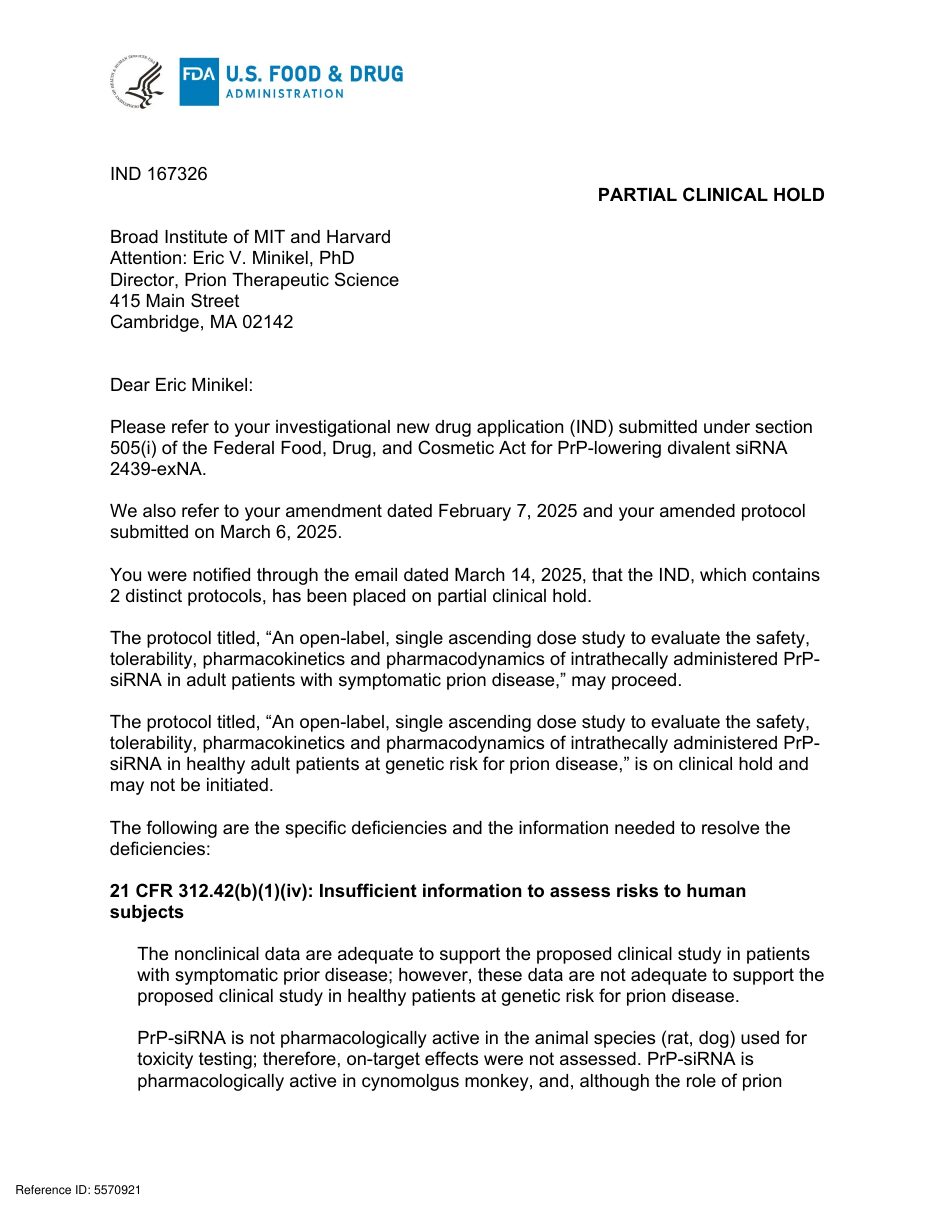
Source excerpt · Letter ¶1–3; signature page, April 11, 2025The letter itself misspells the asset name — “2349-exNA” — a detail preserved verbatim from the public record.
Broad Institute · Its drug, 2439-exNA, is ready for its first human studies, but the FDA has frozen one of them.
Task 02 · Bioanalytical scientist
Write the defense of what the test may be used for, grounded in the raw lab data, not in hopes for the test.
Claude Opus 5 caught 10 of 12 traps. See which →
3What just happened?
The lab measures prion protein in spinal fluid to see if the drug is working. The FDA says the test must be properly validated before it supports any claim that the drug works. A lab memo argues it is already fit for purpose.
4Who has to do what?
PrP_ELISA_Context_of_Use_Defense.docxGo through the raw plate data, decide what the assay can honestly claim, and write the intended-use defense FDA can rely on.
5Which files decide it?
The model also has the rest of the company’s shared drive, its chat and its record systems. Finding the right files is part of the job. Flip through the key ones below.
Some of the files the model worked from.
FDA placed the presymptomatic study on partial clinical hold because the required animal safety study was never run. Until the agency says otherwise, no activity under that protocol may begin.
Two protocols, two different answers: the symptomatic study may proceed; the presymptomatic study may not be initiated. Every file in this record exists to answer this letter.
6What did the model do?
In short: It recomputes the lab’s statistics from raw exports, finds plate failures no document ever stated, and invents the missing acceptance rule — then applies it plate by plate.
Step 21. Recomputes the lab's own numbers. Rather than quoting the filing's claims, the model recomputes plate-to-plate ratios from the raw exports — a median shift of 1.17 across the two plates that ran the same samples. This is real bioanalytical work, done from the raw data.
Recomputed statisticsplate44/43 ratios n=12 median=1.174
Step 30. Invents the missing rule — then applies it. No written plate-acceptance rule exists in the file set, so the model derives one from bioanalytical convention and applies it plate by plate — rejecting plate 44, the same plate that produced the high bias. The draft is honest that the rule is new, not filed.
Accept/reject per plateplate 44 REJECT
Step 32. Writes a rigorous framework — but refuses the required label. The framework it writes is sophisticated: two tiers of claimed use, specs fit for a qualification protocol. But it explicitly refuses to call the endpoint "exploratory" — the exact restriction the task required — and its spec table still defines a reportable range for clinical plates before the human-matrix qualification it defers. Two of twelve checks fail here.
Framework written into the draftdescribing the endpoint as "exploratory
Bears on: Call the test exploratory onlyHold patient results until the test is qualified
Replay every step of the run →
Recomputes the lab's own numbers
plate44/43 ratios n=12 median=1.174
Rather than quoting the filing's claims, the model recomputes plate-to-plate ratios from the raw exports — a median shift of 1.17 across the two plates that ran the same samples. This is real bioanalytical work, done from the raw data.
7Which traps did it catch?
Specialists wrote these checks from the real records before any model ran. Each is a weak spot a reviewer or inspector would find. A check passes only if the handed-in file states it.
Today’s results can show whether the protein goes down, but can’t be used to prove the drug works or to justify the dose.
If missed, weak data get used to claim the drug works.
The memo wants to release results with a footnote. Quality should hold them until the human-sample qualification is done.
If missed, unreliable patient results enter the record.
The protocol calls the test “validated”, but no validation in human spinal fluid exists.
If missed, the filing repeats a claim that isn’t true.
The raw files show mouse-based control samples, including old batches, not human ones.
If missed, the defense describes controls that were never run.
The memo wants to use the mouse controls as a bridge; different species and fluid make that unacceptable.
If missed, human results are calibrated against the wrong thing.
Some spinal taps pick up blood. The memo proposes correcting for it with a formula; the fix is careful collection and a clear rejection rule.
If missed, contaminated samples are “corrected” into false results.
Nothing on file says when a test run counts as valid, and past precision doesn’t substitute for one.
If missed, bad runs can’t be rejected.
Validation plans go to the FDA for review before the test supports efficacy trials, as the FDA asked.
If missed, the lab validates the test in a way the FDA may reject.
Repeat measurements need a planned study in human samples with a numeric pass rule, not leftover mouse pairs.
If missed, the test’s reproducibility in patients is never shown.
The quoted ~9% variation combines biology and lab noise from repeat taps, so it isn’t the test’s own precision.
If missed, the test looks more precise than it is.
The lab’s own exports show a few percent variation within a plate but about 16–17% between plates.
If missed, run limits are set from borrowed numbers.
An old control batch run beside the new one reads consistently higher, so every reagent change needs a planned bridging test.
If missed, a reagent switch shifts results without anyone noticing.
One attempt each, same assignment and checklist, so treat small gaps as noise.
PrP_ELISA_Context_of_Use_Defense.docx the file you download is the graded artifact · sha256 2980eff1449e…
From the recordEvery assay in the file ran on mouse brain homogenate. There are zero human spinal-fluid samples in the record.
Talk to usRequest the full Biopharma Bench V0.1 — company environments and run files: team@raycaster.ai